
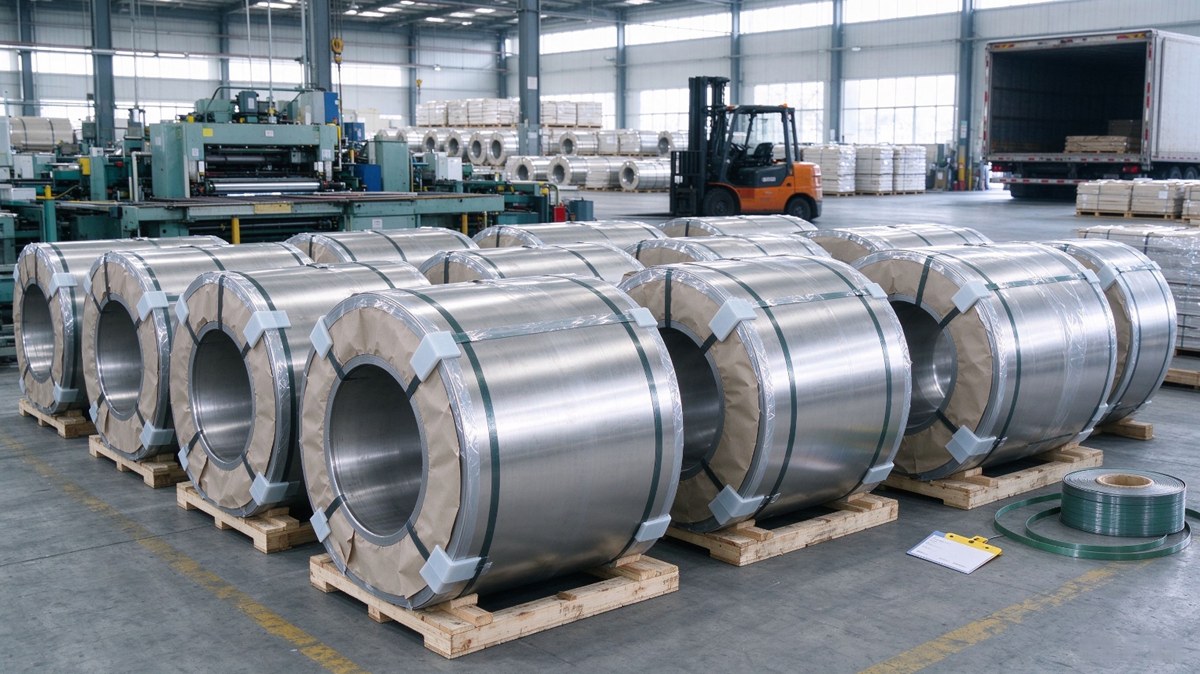
MATERIAL INTRODUCTION
304 Stainless Steel Strip
General-purpose austenitic stainless steel strip, the most widely used cold-rolled precision stainless steel strip, density: 7.93 g/cm³.
- Grade
- 304
- Thickness
- 0.02–3.0 mm
- Width
- 2 mm
Chemical Composition (wt%)
| C | Cr | Ni | Mn | Si |
|---|---|---|---|---|
| ≤0.08 | 18.0~20.0 | 8.0~10.5 | ≤2.0 | ≤1.0 |
Applicable Standards
| Standard / Designation |
|---|
| GB/T 3280 |
| JIS G4305 / JIS G4313 |
| ASTM A240 |
| EN 10088-2 |
Tempers & Hardness
| Temper | Hardness / Characteristics |
|---|---|
| ANN (Annealed, Soft Temper) | HV ≤200, good elongation, suitable for deep drawing and bending |
| 1/4H | 220–250 HV |
| 1/2H | 250–310 HV (Most commonly used half-hard material for stamping) |
| 3/4H | 310–370 HV |
| FH (Full Hard) | ≥370 HV, good elasticity but prone to cracking during bending |
Common Surface Finishes
| Surface | Description / Applications |
|---|---|
| 2B | Matte silver finish, highest cost-performance, primary grade for industrial stamping |
| BA (Bright Annealed) | Bright reflective surface, for cosmetic parts |
| No.4, HL Hairline, 8K Mirror | For decorative applications |
Size Range & Precision Slitting (Edge trimming and deburring)
0.02–3.0 mmThickness
2 mmWidth
±0.002 mmTight tolerance available
Can be slit and precision cut per drawings. Please confirm required dimensions and achievable tolerances with your inquiry.
Material Features
- Resistant to atmospheric, fresh water and weak acid corrosion; inferior to 316L in chloride environments (seawater, brine)
- Heat resistance: Long-term service temperature ≤800℃, excellent low-temperature toughness
- Good weldability. 304L low-carbon variant offers better intergranular corrosion resistance after welding
- Remarkable work-hardening upon cold working; not recommended for high-fatigue springs (301, 316L or SWP stainless steel wire are preferred for springs)
Applications
Electronic shielding cans, bellows, hoses, food processing equipment, kitchenware, decorative strips, pressure vessels, battery components, precision gaskets, stamped housings, etc.
Material Comparison
| Grade | Key Characteristics |
|---|---|
| 304 | Good stamping performance, general corrosion resistance, moderate cost, average elasticity |
| 301 | Also austenitic grade, achieves higher hardness after cold working, ideal for spring contacts |
| 304L | Low-carbon grade, priority choice for welding applications |
| 316L | Contains molybdenum for superior chloride resistance, higher cost |